

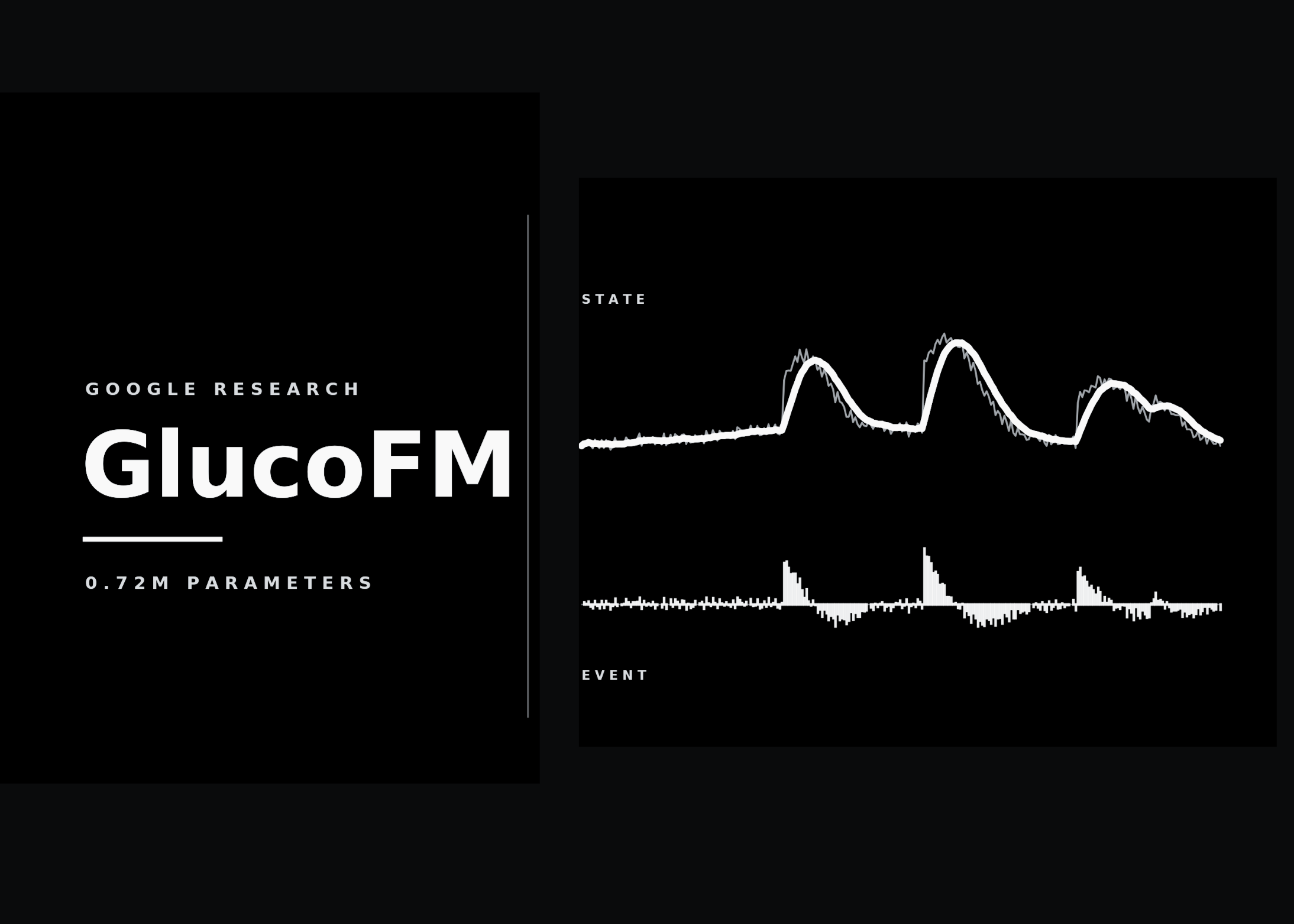

Google Research and UNSW Sydney have released GlucoFM, a self-supervised foundation model for continuous glucose monitoring. Its core move is a split. Existing CGM models — CGMformer, GluFormer, CGM-JEPA — encode a glucose trace as one entangled sequence. GlucoFM decomposes it into a slow physiological “state” stream and a transient “event” stream, keeps the observation mask intact, and pretrains with two JEPA-style latent objectives. The result is a 0.72M-parameter encoder that reached 58.8 task-averaged PR-AUC across 14 cohort–task evaluations, against 54.7 for the strongest CGM-specific baseline retrained on the same corpus. It was pretrained on 109,066 hours of unlabeled CGM from 477 subjects, on a single H100.
Is it deployable?
As research infrastructure, yes. As a clinical or consumer product, not yet.
The research team state it directly: GlucoFM is a research prototype, has not been cleared or approved by any regulatory authority, and is not intended to diagnose, treat, cure or prevent disease. Every evaluation is retrospective, the largest pretraining cohort is non-public, and no checkpoint has shipped as of 26 August 2026 — the paper commits to releasing code and reproducibility scripts.
What is deployable today is the recipe. At 0.72M trainable parameters and 120 epochs on a single NVIDIA H100, any team with a CGM corpus can reproduce it, and 24-hour-window inference runs on a CPU container or on-device.

The problem with treating CGM as one signal
Existing CGM foundation models like CGMformer, GluFormer and CGM-JEPA encode a glucose trace as a single entangled sequence. But CGM carries two things at once: a slow regulatory baseline, and short transient deviations from meals, activity, stress or sensor artifacts. Clinical labels are also expensive and cohort-specific, which caps supervised training.
Architecture
GlucoFM aligns each recording to a fixed 24-hour grid at Δt = 5 minutes, giving L = 288 positions, and preserves the absolute circadian start index. An observation mask M is retained end to end — missing positions are filled only to build a tensor and never counted as measurements. An ablation shows dense interpolation underperforms this mask-aware default.
A causal, mask-aware learnable Gaussian filter then splits the signal: the filtered trend becomes the state stream, the masked residual the event stream. Bandwidth σ is learnable within 2–12 grid steps, roughly 10–60 minutes, initialized at 6.0. A one-sided kernel enforces causality, so future glucose never leaks into the current state estimate.
Both streams are tokenized into 24 one-hour patches, fused into 128-dimensional tokens, and given circular time-of-day features. Pretraining uses two JEPA-style objectives: masked contextual latent prediction over 50–60% of patches against an EMA teacher (m = 0.997), and next-patch state/event dynamics prediction via residual transition heads. CGM-aware augmentations add baseline wander, compression-like drops, decimation to 15-minute sampling, and disconnection blocks.
The encoder is a 3-layer Transformer, hidden dimension 128, 4 heads, feed-forward 256 — 0.72M trainable and 1.18M total parameters. Pretraining used 109,066 hours of unlabeled CGM from 477 subjects across Wear-CGM, ShanghaiT2DM, Stanford, BIG IDEAs and Colas. <!– INTERACTIVE EXPLAINER EMBED GOES HERE –>
Results
Under subject-disjoint linear probing across four cohorts and seven tasks (14 cohort–task evaluations), GlucoFM reached 58.8 task-averaged PR-AUC against 54.7 for the strongest CGM-specific baseline retrained on the same corpus — +4.1 points, about 7.5% relative — and 5.8 above the best GluFormer variant. It led PR-AUC on every diabetes-risk and beta-cell-dysfunction evaluation and 3 of 4 insulin-resistance evaluations, and ranked first on 21 of 24 cross-dataset transfer evaluations.
For two-hour postprandial glycemic response forecasting it reached 21.88 mg/dL MAE with full context, against 22.90 for the best baseline and 27.69 for a train-fold mean, over 874 meal events from 34 participants across Dexcom and Libre sensors. It also beat a seven-day GMI threshold rule on macro-F1 by +7.4 points on Stanford and +17.4 on CGMacros-Dexcom. Trained on 20% of the corpus, it already matched CGM baselines trained on all of it.
Key Takeaways
- GlucoFM splits CGM into a slow “state” stream and a transient “event” stream instead of one entangled sequence.
- 0.72M trainable parameters beat a 135M GluFormer and a 385M MOMENT on task-averaged PR-AUC.
- 58.8 vs 54.7 PR-AUC over the best same-corpus CGM baseline across 14 cohort–task evaluations.
- Strongest gains are on diabetes risk, beta-cell dysfunction and insulin resistance — the clinically central tasks.
- It is a research prototype with no regulatory clearance and no public checkpoint yet.
Check out the Paper and Technical Details. Also, feel free to follow us on Twitter and don’t forget to join our 150k+ML SubReddit and Subscribe to our Newsletter. Wait! are you on telegram? now you can join us on telegram as well.
Need to partner with us for promoting your GitHub Repo OR Hugging Face Page OR Product Release OR Webinar etc.? Connect with us
Michal Sutter is a data science professional with a Master of Science in Data Science from the University of Padova. With a solid foundation in statistical analysis, machine learning, and data engineering, Michal excels at transforming complex datasets into actionable insights.