

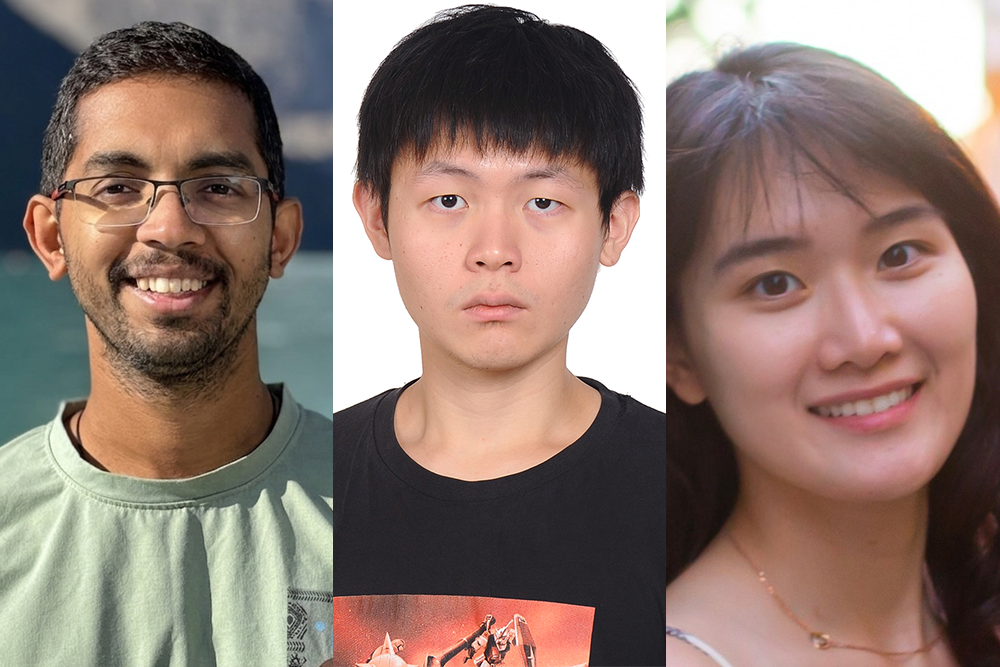

The experience of transitioning from research based in theory to focusing on real-world application can vary significantly for different researchers. However, for two former MIT graduate students and a former postdoc, all now at IBM, working with the MIT-IBM Computing Research Lab (formerly the MIT-IBM Watson AI Lab) during their formative years enabled them to not only close the gap between education and employment, but also to generate ideas promising to business impact.
Despite pursuing varied careers in quantum machine learning, reinforcement learning and artificial intelligence agents,and trustworthy and fair AI, respectively, Srinivasan Arunachalam, Zhang-Wei Hong PhD ’25, and Irene Ko PhD ’24 have consistently found ways to tackle problems defined by novelty and rigor, and translate them to systems with real constraints. Here, the MIT-IBM Computing Research Lab served as a conduit for research relationship building and the flow of their expertise to industry applications.
“Among all the industrial labs, I think MIT-IBM has way better academic collaboration policy and opportunity [than the others],” says Hong, an IBM research staff member with the MIT-IBM Computing Research Lab who began his PhD at MIT in 2020 in the Department of Electrical Engineering and Computer Science (EECS).
Hong has been captivated with reinforcement learning since discovering that DeepMind could play Atari and learn from raw screen pixels via feature engineering. During his graduate work with EECS Associate Professor Pulkit Agrawal, who is also a principal investigator with the lab, Hong sought to build on this: improving value function learning for reinforcement learning in video games, using “Montezuma’s Revenge” in Atari, in order to predict and optimize the policy performance of an agent. With the lab, Hong developed techniques to ground AI for more realistic applications and provide better reward feedback, which he applied to domains such as robotics, large language models (LLMs), and reinforcement learning for science.
“I’m very excited about curiosity-driven exploration,” says Hong of the MIT-IBM graduate work that helped propel him into his profession. This, he says, allows agents to be inquisitive about new data, like humans, and perform a variety of tasks — from generating test cases to stress-test LLMs to exploring new environments. Now, as a mentor for students of his own, Hong continues to pursue similar lines of open-ended reinforcement learning research, leading him to investigate test-time training for agents and foundation models, and develop infrastructure for IBM’s agentic framework for enterprise tasks like chart reading and tool calling for database queries. This includes evolutionary computing to drive better optimization for exploration and leveraging neuroscience to inform deployment time model improvement.
“If successful, I think that it would be a very useful system and framework for all of the practitioners in reinforcement learning, because it will be the first framework that enables a model to improve — self-evolve their model weights online at a deployment time,” says Hong.
Irene Ko’s research has also been value-driven, from a personal and professional standpoint. “I started to work [on trustworthy AI] with IBM researchers from day 1 in my PhD, because it was funded by MIT-IBM,” says Ko. This, she says, was particularly advantageous since her goals to develop frontier-safe, robust, accurate, and fair AI also align with that of MIT and IBM, closing the gap between development and real-world deployment. “That really strikes a balance between pure research and something that’s of industry standard or value.”
Further, her MIT-IBM collaboration through her advisor in EECS, Joseph F. and Nancy P. Keithley Professor Luca Daniel, and IBM Principal Research Scientist Pin-Yu Chen, helped define the direction and parameters of her work to maximize impact, first in neural networks and later with foundation models and LLMs. After graduating in 2024, Ko joined IBM Research to continue her work on trustworthy AI as a research scientist.
“The reason I chose to go into industry after my PhD, and IBM specifically, is that I found great joy in the collaboration during my PhD. That process, those five years, gave me very high rewards in personal fulfillment,” says Ko. “I wanted to continue the momentum.”
Her current project focuses on finding pain points in current trustworthy methods that are not widely deployed in AI inference platforms. Unlike using low-rank adapters, which add extra steps to monitor and modify model behavior, her work on vLLM Hook provides a way to access internal model signals, like hidden states or activations, for decoding LLMs. This vector acts on transformer modules to analyze safety scores, such as identifying the likelihood of prompt-injection and hallucination. Here, Ko has developed a lightweight vLLM inference engine plugin framework to program the model internals that could provide significant cost savings over other methods. “I’m very proud of this project because this is really, as far as we know, the first bridge between the deployment and development in trustworthy AI with the inference engines.”
While Srinivasan Arunachalam has always dabbled in quantum research, he constantly explores other areas of theory, seeking to find quantum insights and deep math in unexpected lines of inquiry and papers. “Right off the bat, you don’t see it. You think, maybe this is just a vanilla problem, and then once you start investigating it further, you find some really interesting math that comes out of it, which I think is pretty cool,” he says.
This drew Arunachalam to MIT as a postdoc in 2018 in the group of Professor Aram Harrow in the Department of Physics. With a learning theory-first perspective, Arunachalam looked for target algorithms, subroutines, and circuits where quantum speed-ups might be possible. Conversations with Isaac Chuang, the Julius A. Stratton Professor in Electrical Engineering and Physics and an MIT-IBM PI, led him to collaborate with the lab and IBM researcher Kristan Temme.
With a seamless transition to IBM, Arunachalam more closely involved himself with problems that are potentially implementable on a near-term quantum device, keeping in mind constraints like nearest-neighbor architecture, noise, and simpler observable measurements. During this time, Arunachalam focused on quantum machine learning and areas where quantum computing would be superior to classical computing, increasingly prioritizing provability grounded in theory to heuristics. That MIT-IBM connection helped turn theoretical questions into concrete research directions, shaping work that culminated in two prominent papers: one on Hamiltonian learning, which gave rigorous guarantees for learning the dynamics of quantum systems, and another on quantum kernels, which provided theoretical evidence that quantum feature spaces can offer advantages over classical kernels under widely believed hardness assumptions.
Arunachalam also continued to expand his knowledge base by pouring himself into different branches of computer science to uncover structure in problems others may have missed. “One thing which I’ve been a huge fan of is exposing connections between different fields.” This has allowed him to explore learning quantum states — from completely classically simulatable quantum objects to the extremely complicated quantum objects.
Although Hong, Arunachalam, and Ko navigate different domains, they share an instinct: to move ideas across the space between what is possible in principle and what is useful in practice. In their own way, each is applying knowledge gained from collaborations, like that of MIT-IBM Computing Research Lab, to develop “killer applications” — a real-world use case that proves the underlying research can matter beyond the lab.