


Close Menu
Techora News HubTechora News Hub
    Facebook X (Twitter) Instagram
    Techora News HubTechora News Hub
    • Home
    • Crypto News
      • Bitcoin
      • Ethereum
      • Altcoins
      • Blockchain
      • DeFi
    • AI News
    • Stock News
    • Learn
      • AI for Beginners
      • AI Tips
      • Make Money with AI
    • Reviews
    • Tools
      • Best AI Tools
      • Crypto Market Cap List
      • Stock Market Overview
      • Market Heatmap
    • Contact
    Techora News HubTechora News Hub
    Home»Crypto News»Altcoins»Ethereum’s quantum defense plans could delay a major upgrade to stop transaction censorship
    Altcoins

    Ethereum’s quantum defense plans could delay a major upgrade to stop transaction censorship

    November 27, 2026
    Facebook Twitter Pinterest Telegram LinkedIn Tumblr WhatsApp Email
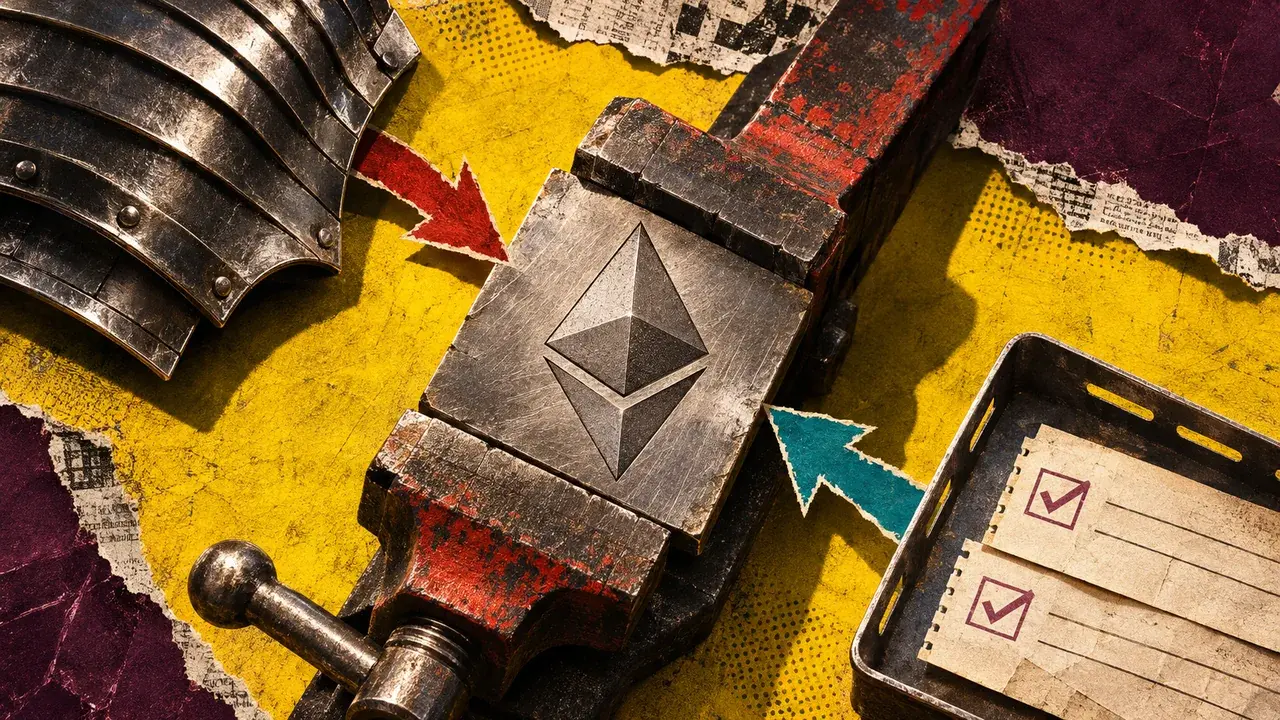
    A bench vise grips a steel plate engraved with the Ethereum diamond between ribbed armor and a tray of checkmarked slips.
    Share
    Facebook Twitter LinkedIn Pinterest Telegram Email
    changelly


    Ethereum’s core developers kept a proposal to curb transaction censorship on the schedule for an upgrade called Hegotá at their Nov. 26 meeting.

    They deferred a final decision while client teams considered whether the work could run alongside efforts to make the network’s consensus system resistant to quantum attacks.

    The proposal, known as FOCIL, remains Hegotá’s lead consensus change. The All Core Devs call record puts the next review of the fork’s scope around Dec. 10.
    Related Reading

    quillbot

    Ethereum’s Glamsterdam delay reveals a troubling pattern behind its biggest network upgrades

    Under draft EIP-7805, a committee of validators would broadcast lists of transactions waiting in the public queue. Validators that vote on the next block would check the lists they received before a cutoff.

    If a builder leaves out a listed transaction that is still valid at the end of the block and fits in the remaining gas, those validators would withhold their votes. They would ignore lists from a committee member they saw send conflicting versions.

    For someone whose eligible transaction makes a timely list, a builder’s decision to leave it out could cost that block its votes.

    Where the work could collide with other Ethereum proposals

    EthPandaOps’ October Heze devnet plan carried forward tests of list propagation, timing, and how inclusion lists interact with the separation of block builders and proposers.

    The team kept Frame Transactions, another Hegotá proposal, on a separate test track. The proposed Bogotá devnet would focus on execution-layer testing while teams wait for a decision before running a combined test.

    FOCIL co-author Jihoon Song argues that developers and testers can move inclusion lists toward release while researchers work on post-quantum decoupled consensus, a redesign of how Ethereum agrees on blocks.

    He would start with preregistration so validators can register new keys ahead of a switch in how they sign. Song expects most FOCIL work to be done by the time the consensus design is ready for client teams to implement for mainnet.

    At the Nov. 24 post-quantum breakout, developers discussed how to restore a test network that stalled after some clients took too long to generate new validator keys. The test is part of the early consensus work the Ethereum Foundation described in its Nov. 23 update.

    Ethlabs researcher Caspar Schwarz-Schilling argues that a small group of researchers and client developers with a broad view of Ethereum would be needed to deliver both changes safely.

    He favors deferring FOCIL so that group can focus on consensus. The extent of the overlap depends in part on what developers expect the first version of FOCIL to handle.

    The Catalyst

    Know what’s moving crypto.

    Two ways to sequence Ethereum’s upgradesTwo proposals under discussion. Song would develop FOCIL alongside quantum-safe consensus research. Schwarz-Schilling would prioritize the quantum transition and revisit FOCIL afterward.JIHOON SONGAdvance both in parallelKeep FOCIL in HegotáDevelopment and testingDesign quantum-safe consensusBegin with key preregistrationCASPAR SCHWARZ-SCHILLINGPut the quantum transition firstPrioritize quantum-safe consensusConcentrate specialist timeRevisit FOCIL afterwardDefer inclusion lists for nowIf both upgrades shipHow are the lists signed after the switch?Which validators enforce them under the new consensus design?
    Two ways to sequence Ethereum’s upgradesTwo proposals under discussion. Song would develop FOCIL alongside quantum-safe consensus research. Schwarz-Schilling would prioritize the quantum transition and revisit FOCIL afterward.JIHOON SONGAdvance both in parallelKeep FOCIL in HegotáDevelopment and testingDesign quantum-safe consensusBegin with key preregistrationCASPAR SCHWARZ-SCHILLINGPut quantum work firstPrioritize quantum workConcentrate specialist timeRevisit FOCIL afterwardDefer inclusion lists for nowIf both upgrades shipHow are the lists signed after the switch?Which validators enforce them underthe new consensus design?

    The timing decision affects how soon eligible public transactions could gain stronger protection against being left out.

    The paths show proposed sequencing. They convey no duration, staffing commitment or final fork decision.

    The FOCIL draft relies on BLS signatures to authenticate the lists themselves, and those signatures would eventually need a quantum-resistant replacement.

    In a separate technical analysis, Song also identifies work on how lists would carry larger post-quantum transactions or the proofs that could accompany them without overloading the network.

    The decoupled consensus design also leaves open which group of validators would enforce the lists.

    Barnabas Busa proposed a narrower version that would enforce inclusion for certain existing transaction types and excuse builders from including Frame Transactions.

    Inclusion lists could then protect users of those existing transaction types in Hegotá, while users of Frame Transactions would have to wait for enforcement to cover them.

    The next post-quantum consensus session is scheduled for Nov. 27 at 14:00 UTC. When developers return to Hegotá’s scope, the practical test is how much work the first version needs from the people designing the new consensus system.



    Source link

    aistudios
    Share. Facebook Twitter Pinterest LinkedIn Tumblr Email

    Related Posts

    UK DeFi Rules Under Fire Over $6.3 Billion Binance Hack

    November 26, 2026

    Chainflip’s post-hack refunds leave liquidity providers facing a second financial problem

    November 25, 2026

    Researchers Warn $72B in ETH Faces Future Quantum Risk

    November 24, 2026

    BlackRock’s staked Ethereum ETF and redemption delays

    November 23, 2026

    Dogecoin (DOGE) Flashes a Major Bullish Signal: Big Rebound Ahead?

    November 22, 2026

    Bitquery Traces $13.5M in Suspicious Token Sales

    November 21, 2026
    coinbase
    Latest Posts

    Making money with AI short dramas is simple (just copy me)

    November 27, 2026

    How I Built a Crypto Trading Bot with Claude Code AI (AI Trading Strategy Guide)

    November 27, 2026

    Higgsfield AI Tutorial for Beginners 2026 (Complete Guide)

    November 27, 2026

    BNB Chain Reveals New Blockchain for Private DeFi

    November 27, 2026

    Ethereum’s quantum defense plans could delay a major upgrade to stop transaction censorship

    November 27, 2026
    kraken
    LEGAL INFORMATION
    • Privacy Policy
    • Terms Of Service
    • Social Media Disclaimer
    • DMCA Compliance
    • Anti-Spam Policy
    Top Insights

    Injective Urges SEC to Open Tokenized Stock Trading to Order Books

    November 27, 2026

    Bluefin to Shut Down Perps, Refocus on Spot Trading and Tokenized RWAs

    November 27, 2026
    notion
    Facebook X (Twitter) Instagram Pinterest
    © 2026 TechoraNewsHub.com - All rights reserved.

    Type above and press Enter to search. Press Esc to cancel.

    bitcoin
    Bitcoin (BTC) $ 59,926.00
    ethereum
    Ethereum (ETH) $ 1,663.53
    tether
    Tether (USDT) $ 0.999385
    bnb
    BNB (BNB) $ 554.97
    usd-coin
    USDC (USDC) $ 0.999796
    xrp
    XRP (XRP) $ 0.948168
    solana
    Solana (SOL) $ 71.71
    tron
    TRON (TRX) $ 0.300727
    staked-ether
    Lido Staked Ether (STETH) $ 2,265.05
    figure-heloc
    Figure Heloc (FIGR_HELOC) $ 1.01