


Close Menu
Techora News HubTechora News Hub
    Facebook X (Twitter) Instagram
    Techora News HubTechora News Hub
    • Home
    • Crypto News
      • Bitcoin
      • Ethereum
      • Altcoins
      • Blockchain
      • DeFi
    • AI News
    • Stock News
    • Learn
      • AI for Beginners
      • AI Tips
      • Make Money with AI
    • Reviews
    • Tools
      • Best AI Tools
      • Crypto Market Cap List
      • Stock Market Overview
      • Market Heatmap
    • Contact
    Techora News HubTechora News Hub
    Home»AI News»OpenAI Releases Symphony: An Open Source Agentic Framework for Orchestrating Autonomous AI Agents through Structured, Scalable Implementation Runs
    AI News

    OpenAI Releases Symphony: An Open Source Agentic Framework for Orchestrating Autonomous AI Agents through Structured, Scalable Implementation Runs

    March 5, 2026
    Facebook Twitter Pinterest Telegram LinkedIn Tumblr WhatsApp Email
    OpenAI Releases Symphony: An Open Source Agentic Framework for Orchestrating Autonomous AI Agents through Structured, Scalable Implementation Runs
    Share
    Facebook Twitter LinkedIn Pinterest Telegram Email
    synthesia


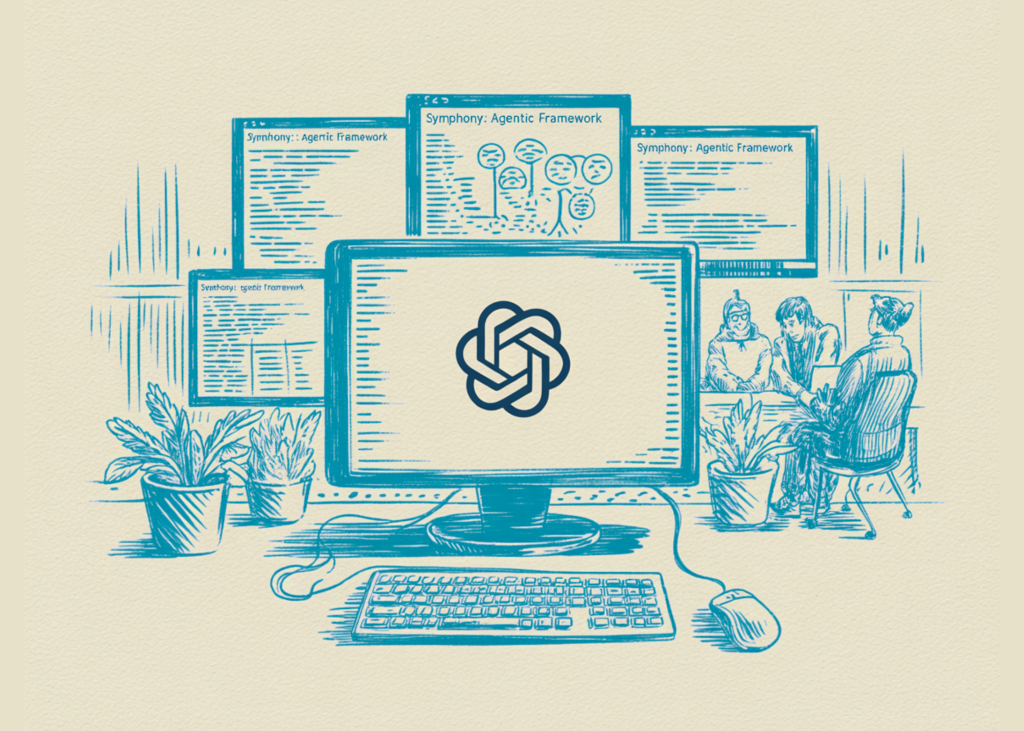
    OpenAI has released Symphony, an open-source framework designed to manage autonomous AI coding agents through structured ‘implementation runs.’ The project provides a system for automating software development tasks by connecting issue trackers to LLM-based agents.

    System Architecture: Elixir and the BEAM

    Symphony is built using Elixir and the Erlang/BEAM runtime. The choice of stack focuses on fault tolerance and concurrency. Since autonomous agents often perform long-running tasks that may fail or require retries, the BEAM’s supervision trees allow Symphony to manage hundreds of isolated implementation runs simultaneously.

    The system uses PostgreSQL (via Ecto) for state persistence and is designed to run as a persistent daemon. It operates by polling an issue tracker—currently defaulting to Linear—to identify tasks that are ready for an agent to address.

    bybit

    The Implementation Run Lifecycle

    The core unit of work in Symphony is the implementation run. The lifecycle of a run follows a specific sequence:

  • Polling and Triggering: Symphony monitors a specific state in the issue tracker (e.g., ‘Ready for Agent’).
  • Sandbox Isolation: For each issue, the framework creates a deterministic, per-issue workspace. This ensures the agent’s actions are confined to a specific directory and do not interfere with other concurrent runs.
  • Agent Execution: An agent (typically using OpenAI’s models) is initialized to perform the task described in the issue.
  • Proof of Work: Before a task is considered complete, the agent must provide ‘proof of work.’ This includes generating CI status reports, passing unit tests, providing PR review feedback, and creating a walkthrough of the changes.
  • Landing: If the proof of work is verified, the agent ‘lands’ the code by submitting or merging a Pull Request (PR) into the repository.
  • Configuration via WORKFLOW.md

    Symphony utilizes an in-repo configuration file named WORKFLOW.md. This file serves as the technical contract between the developer team and the agent. It contains:

    • The agent’s primary system instructions and prompts.
    • Runtime settings for the implementation environment.
    • Specific rules for how the agent should interact with the codebase.

    By keeping these instructions in the repository, teams can version-control their agent policies alongside their source code, ensuring that the agent’s behavior remains consistent with the specific version of the codebase it is modifying.

    Harness Engineering Requirements

    The documentation specifies that Symphony is most effective in environments that practice harness engineering. This refers to a repository structure that is optimized for machine interaction. Key requirements include:

    • Hermetic Testing: Tests that can run locally and reliably without external dependencies.
    • Machine-Readable Docs: Documentation and scripts that allow an agent to discover how to build, test, and deploy the project autonomously.
    • Modular Architecture: Codebases where side effects are minimized, allowing agents to make changes with high confidence.

    Key Takeaways

    • Fault-Tolerant Orchestration via Elixir: Symphony utilizes Elixir and the Erlang/BEAM runtime to manage agent lifecycles. This architectural choice provides the high concurrency and fault tolerance necessary for supervising long-running, independent ‘implementation runs’ without system-wide failures.
    • State-Managed Implementation Runs: The framework transitions AI coding from manual prompting to an automated loop: it polls issue trackers (like Linear), creates isolated sandboxed workspaces, executes the agent, and requires ‘Proof of Work’ (CI passes and walkthroughs) before code is merged.
    • Version-Controlled Agent Contracts: Through the WORKFLOW.md specification, agent prompts and runtime configurations are stored directly in the repository. This treats the AI’s operating instructions as code, ensuring that agent behavior is versioned and synchronized with the specific branch it is modifying.
    • Dependency on Harness Engineering: For the system to be effective, repositories must adopt harness engineering. This involves structuring codebases for machine legibility, including hermetic (self-contained) test suites and modular architectures that allow agents to verify their own work autonomously.
    • Focused Scheduler Scope: Symphony is defined strictly as a scheduler, runner, and tracker reader. It is designed specifically to bridge the gap between project management tools and code execution, rather than serving as a general-purpose multi-tenant platform or a broad workflow engine.

    Check out the Repo here. Also, feel free to follow us on Twitter and don’t forget to join our 120k+ ML SubReddit and Subscribe to our Newsletter. Wait! are you on telegram? now you can join us on telegram as well.



    Previous articleHow to Design an Advanced Tree-of-Thoughts Multi-Branch Reasoning Agent with Beam Search, Heuristic Scoring, and Depth-Limited Pruning


    Source link

    livechat
    Share. Facebook Twitter Pinterest LinkedIn Tumblr Email

    Related Posts

    Baseten Releases Bison-1 and Groundhog-1, Topping Decision Model Index

    November 21, 2026

    Four Chatbots Gave GAO Viable Attack Plans in Under 12 Hours

    November 20, 2026

    This featherweight, flying robot carries its own sensors and computers | MIT News

    November 19, 2026

    Anthropic Adds Code Mode to Claude Code: Claude Now Chains Tool Calls in JavaScript

    November 18, 2026

    California Sues OpenAI for Losing Control of AI Agents 80 Times

    November 17, 2026

    New AI “copilot” helps engineers design better structures | MIT News

    November 16, 2026
    Customgpt
    Latest Posts

    The Fastest Way to Make Money With AI Content

    November 21, 2026

    Give me 10 minutes, and I’ll teach you how to become a Top Data Analyst | Free Course + Certificate

    November 21, 2026

    How to Make AI Videos for Beginners (Higgsfield Full Guide 2026)

    November 21, 2026

    Bitquery Traces $13.5M in Suspicious Token Sales

    November 21, 2026

    Variational’s $1.5 billion trading business has a catch even profitable traders cannot escape

    November 21, 2026
    10web
    LEGAL INFORMATION
    • Privacy Policy
    • Terms Of Service
    • Social Media Disclaimer
    • DMCA Compliance
    • Anti-Spam Policy
    Top Insights

    Crypto Liquidations Top $2.4B As Bitcoin Sinks Below $57K

    November 21, 2026

    Bitcoin Price Sinks Below $60K as Tech Stocks Slide

    November 21, 2026
    kraken
    Facebook X (Twitter) Instagram Pinterest
    © 2026 TechoraNewsHub.com - All rights reserved.

    Type above and press Enter to search. Press Esc to cancel.

    bitcoin
    Bitcoin (BTC) $ 60,099.00
    ethereum
    Ethereum (ETH) $ 1,679.90
    tether
    Tether (USDT) $ 0.99851
    bnb
    BNB (BNB) $ 547.85
    usd-coin
    USDC (USDC) $ 0.999299
    xrp
    XRP (XRP) $ 0.927724
    solana
    Solana (SOL) $ 70.14
    tron
    TRON (TRX) $ 0.304925
    staked-ether
    Lido Staked Ether (STETH) $ 2,265.05
    figure-heloc
    Figure Heloc (FIGR_HELOC) $ 1.05