



Hyperliquid’s Weekly Update highlights the visit Jeff Yan, the DEX’s founder, paid to Harvard Business School the past March 26.


Hyperliquid announces its founder speaking in a HBS class study through its Telegram Channel.
Hyperliquid: The Everything Exchange
As if its growing ascend to the crypto stardom wasn’t enough for Hyperliquid, with recent milestones such as launching the PURR common stock on the Nasdaq Options Market, or rolling out a fiat on-ramp, the leading perp DEX is now on Ivy League levels. Professor Shikhar Ghosh, lecturer Mahesh Ramakrishnan and researcher Shweta Bagai taught a study case on Hyperliquid to MBA students and regulators, as Ramakrishnan said himself on a post on the social network X. As part of the lecture, Ramakrishnan interviewed Jeff Yan.
Posting my recent Harvard Business School case on @HyperliquidX, which we taught to MBA students and regulators earlier this week.
Grateful to @chameleon_jeff and @iliensinc for their help, and for letting me interview Jeff for the class!
You can read the full case below: pic.twitter.com/d2SIKXQ9yf
— MoneroMahesh (@MoneroMahesh) March 26, 2026
The case study, titled “Hyperliquid: The Everything Exchange”, consists in a structured deep dive into Hyperliquid’s architecture, business model, governance, and risk controls. Its aim is to help students and regulators think through where to draw the line between innovation and systemic risk.
Related Reading: Cardano Founder Hoskinson Just Released A Free Book On Zero-Knowledge
As it delves into the history and technical foundation of the platform, the study poses three key questions: Who ultimately controls upgrades and emergency powers on the chain? How transparent are order‑book operations and liquidation mechanics for outside observers? And what happens to users if the “core” team disappears, or if a catastrophic failure hits liquidity?
The case pushes students to compare Hyperliquid’s design choices with centralized exchanges like FTX and with more “credibly neutral” DeFi protocols, explicitly framing it as a test of whether “CeFi in DeFi clothing” is acceptable.
Some independent researchers have argued that Hyperliquid’s stack concentrates significant power in a “core writer” layer that can influence balances, transactions, and even reported volume, blurring the line between on‑chain and off‑chain control. The Harvard study effectively forces students to decide whether such administrative levers are a necessary safety valve or an unacceptable hidden risk, especially after FTX‑Alameda’s use of opaque arrangements and volume games.
Hyperliquid’s liquidation machinery has already drawn scrutiny from on‑chain sleuths and high‑frequency traders. Critics have argued the system can trigger forced unwinds aggressively in fast markets, concentrating risk in the insurance/backstop layer rather than distributing it transparently across participants.
What This Means For Traders
The Harvard case leans into this tension: it explicitly asks whether Hyperliquid’s backstop and insurance mechanisms are robust enough to survive a multi‑sigma meltdown without socialized losses or “special treatment” for favored accounts.
Top business schools and regulators now treat “DeFi” derivatives venues as potential systemically relevant infrastructure, not fringe experiments, which could shape future policy and enforcement priorities. The message to traders is simple: liquidation and backstop design are not academic footnotes: they’re model‑risk levers that decide who eats the loss when volatility hits.
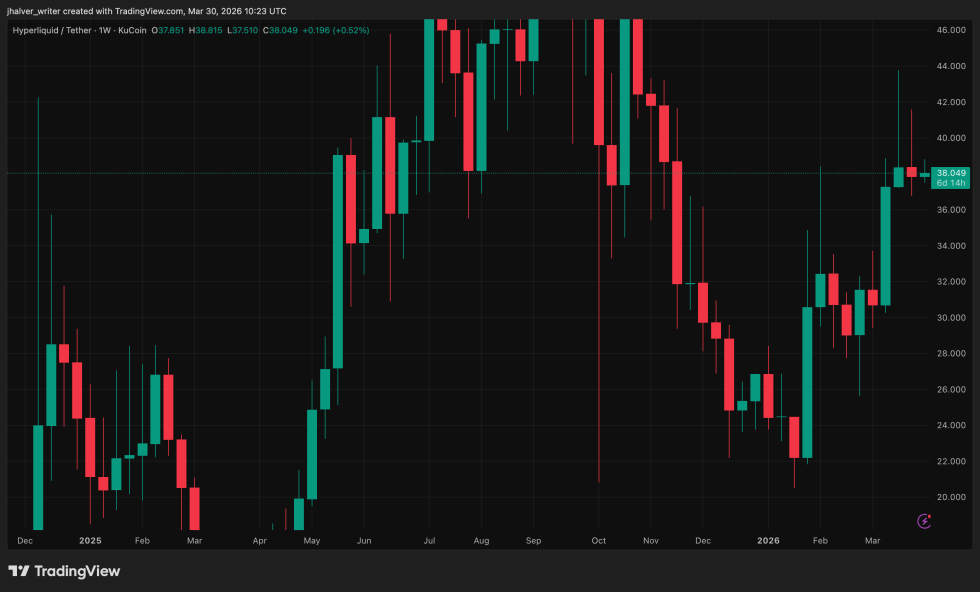
HYPE, Hyperliquid’s native token, trades for $38. Source: HYPEUSDT on Tradingview
Cover image from Perplexity, HYPEUSDT chart from Tradingview

Editorial Process for bitcoinist is centered on delivering thoroughly researched, accurate, and unbiased content. We uphold strict sourcing standards, and each page undergoes diligent review by our team of top technology experts and seasoned editors. This process ensures the integrity, relevance, and value of our content for our readers.