


Key Takeaways
- Satsuma’s 90.6% vote authorizes the sale of 668 bitcoin and a full corporate wind-down.
- Pantera-backed Satsuma lost 99% as treasury-stock discounts exposed wider industry risks.
- Satsuma targets a Sept. 14 delisting and shareholder payments by Sept. 28.
A 90.6% Vote Ends the Experiment
The July 21 vote drew 90.6% support for winding down Satsuma, formerly known as TAO Alpha Plc. The plan calls for the company to dispose of its bitcoin, settle liabilities and distribute the remaining proceeds after costs. Its London Stock Exchange listing is expected to be canceled around Sept. 14, with shareholder payments targeted by Sept. 28.
Satsuma’s exit is significant because it represents one of the clearest full liquidations among publicly traded bitcoin treasury companies. Rather than waiting for a market recovery or seeking another financing round, shareholders chose to dismantle the vehicle and recover what capital remains. Digital asset treasury (DAT), or bitcoin treasury, firms have struggled throughout 2026, and Satsuma now joins the growing list of casualties.
668 Bitcoin Bought Near the Top
The company held 668 bitcoin valued at roughly $44.29 million in mid-July. Those holdings carried an estimated acquisition cost of $75.66 million, or about $113,186 per coin, leaving Satsuma with an unrealized loss of approximately $31.37 million, equal to 41.5%.
Satsuma had raised about $218 million to $221 million in 2025 from investors, including Parafi and Pantera Capital. The company combined its bitcoin treasury strategy with ambitions involving artificial intelligence (AI) and agent-powered subnet economies built around TAO, but the treasury holdings became the central measure of investor value.

One of its largest disclosed purchases came in August 2025, when Satsuma acquired 1,097 bitcoin at an average price of $115,101. Satsuma sold 579 BTC out of its then-holdings of 1,199 BTC in December 2025. The company’s treasury has since been reduced to 668 bitcoin in aggregate.
Shares Fell More Than 99%
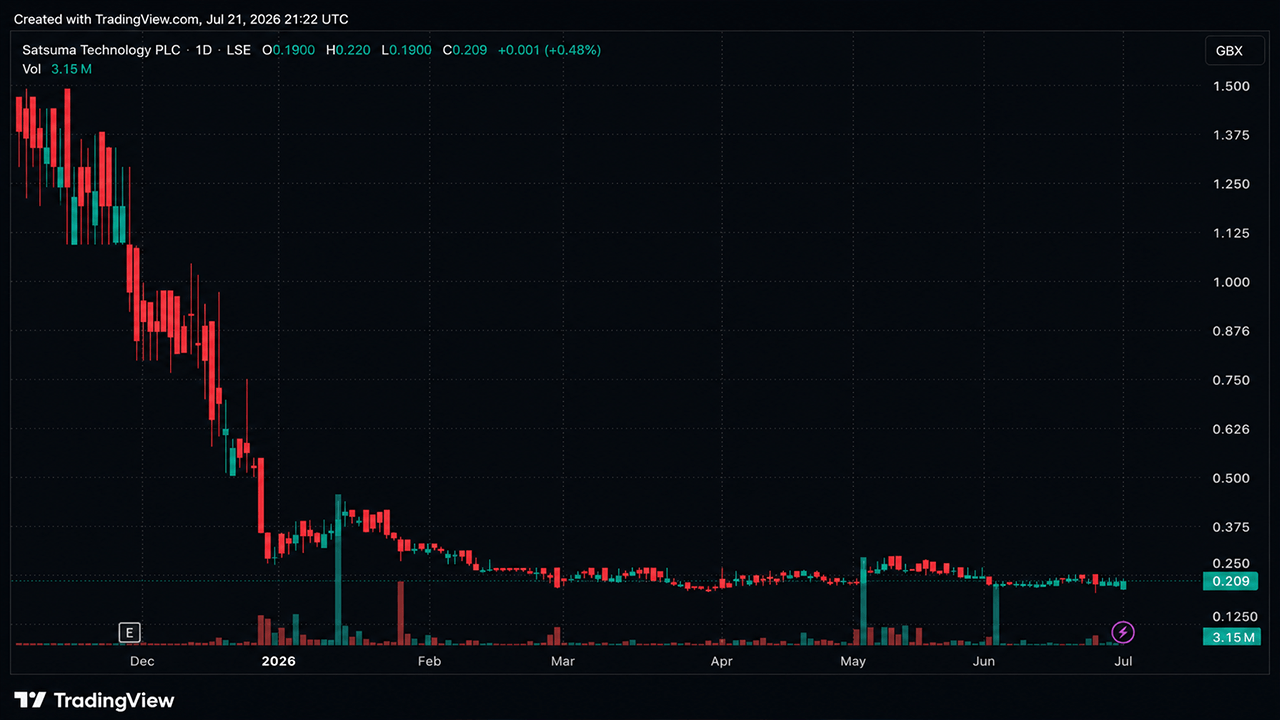
The stock’s collapse proved more severe than bitcoin’s decline. Satsuma shares lost more than 99% from their 2025 peak before trading was suspended at the company’s request on July 1. That erased the equity premium that had helped support treasury companies during the previous year’s expansion.
Pantera began pressing for liquidation as early as April, after the share-price collapse and growing losses. The shareholder vote converted that pressure into a formal exit plan, showing how quickly venture supporters can shift from financing accumulation to demanding capital recovery when a treasury company trades far below the value once assigned to it.
The Treasury Premium Reversed
Bitcoin treasury companies expanded rapidly after Strategy demonstrated that public firms could raise equity and debt, purchase bitcoin and use a rising stock premium to finance additional acquisitions. During favorable markets, issuing shares above net asset value could increase bitcoin holdings per share and reinforce demand for the stock.
That mechanism weakens when shares fall below net asset value. New issuance becomes dilutive, financing costs rise, and investors may prefer direct bitcoin exposure over a corporate wrapper carrying management expenses, operating risks, and governance complications. Satsuma’s liquidation illustrates the end stage of that reversal.
A Broader 2026 Reckoning
Bitcoin fell about 22.6% during the first quarter of 2026, its worst quarterly performance since 2018. It slid more than 14% in the second quarter. Treasury stocks generally absorbed larger losses because their valuations reflected not only the underlying bitcoin but also leverage, financing expectations, and confidence in management’s ability to keep raising capital.
A very large portion of the top 100 largest treasury companies traded below net asset value this year. Nakamoto had fallen more than 98% from its high, while Metaplanet, Upexi and others also traded at deep discounts. Strategy, the sector’s largest holder, traded near 0.81 to 0.83 times net asset value.
High Cost Bases Magnified Losses
Several prominent DATs accumulated bitcoin during the strongest portion of the 2025 market. Metaplanet’s average purchase price was cited near $107,000, Strive’s near $104,000, and Satsuma’s above $113,000. With bitcoin trading below $68,000 in July 2026, those companies carry substantial paper losses.
The problem extended beyond accounting. Treasury companies with loans, collateral requirements, or recurring cash obligations faced pressure to sell assets, issue discounted stock or redirect capital. Smaller firms with thin trading volume were especially vulnerable during the bear market because falling shares reduced financing flexibility just as their bitcoin reserves lost value.
Governance Moves to the Forefront
The vote also places corporate governance at the center of the treasury debate. Bitcoin may be liquid and continuously priced, but shareholders cannot directly control when a listed company buys, sells, borrows, or distributes its holdings. Those decisions remain with directors and influential investors. When market confidence evaporates, the gap between asset ownership and shareholder control becomes especially consequential. Satsuma’s investors ultimately approved liquidation, but only after the stock had collapsed, trading had stopped, and tens of millions of dollars in paper losses had accumulated.
What Satsuma’s Exit Means
Satsuma’s liquidation does not settle the long-term investment case for bitcoin, but it exposes the added risks created by public-company structures. Investors who bought treasury stocks expected amplified bitcoin exposure, yet many received steeper losses, dilution risk, and dependence on boards, lenders, and major shareholders.
The outcome may push surviving treasury companies toward lower leverage, clearer operating businesses, stronger liquidity reserves, and more transparent capital policies. It could also strengthen the appeal of spot exchange-traded funds (ETFs) or direct ownership for investors seeking bitcoin exposure without corporate execution risk.
For the wider market, every liquidation removes a source of institutional demand and can return previously locked bitcoin to circulation. Public companies reportedly held about 1.16 million bitcoin earlier in 2026, so one sale of 668 bitcoin is limited in scale. Still, Satsuma provides a visible warning: treasury strategies built on permanent premiums can unravel when the premium disappears.