

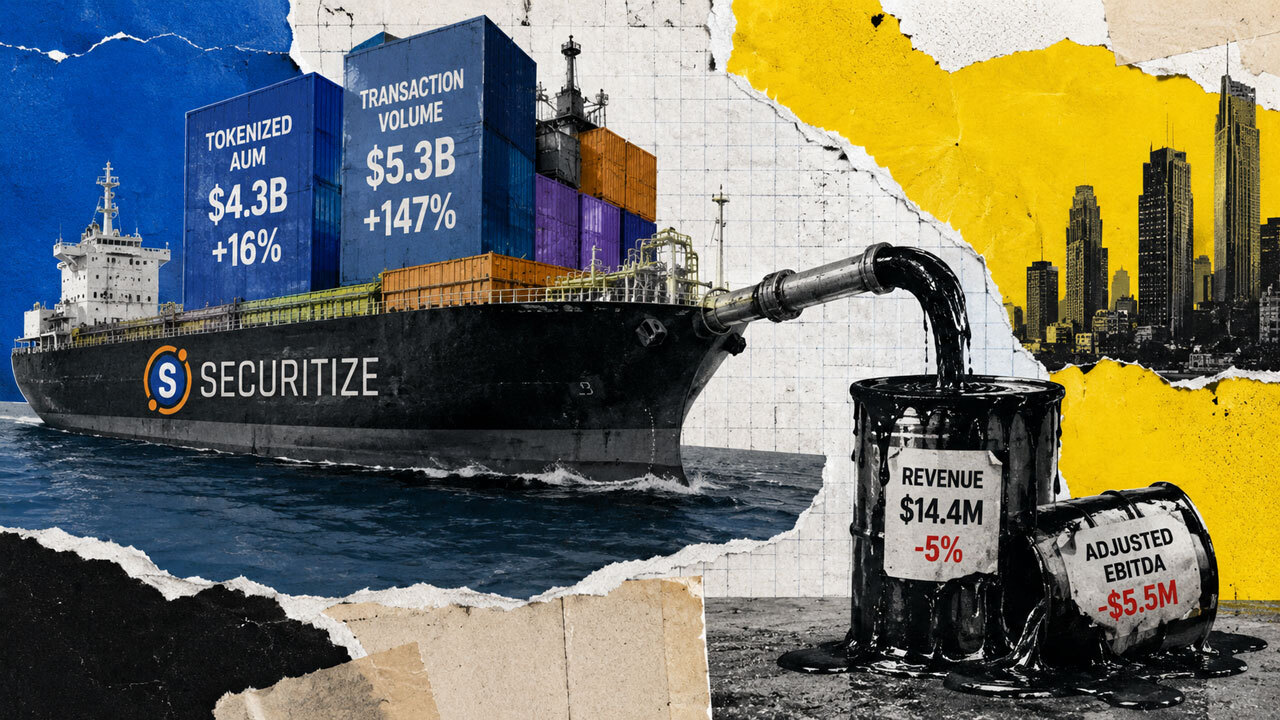
Securitize closed its first quarter as a public company with average tokenized assets under management hitting a record $4.3 billion, up 16% year over year, while transaction volume on the platform jumped 147% to $5.3 billion.
Total revenue fell 5% to $14.4 million, tokenization revenue dropped about 12% to $7.8 million, and adjusted EBITDA swung to a $5.5 million loss.
The company put more assets on-chain and processed far more activity than a year earlier, and earned less money doing it.
MetricQ2 resultYoY changeWhat it showsAverage tokenized AUM$4.3B+16%Assets on-chain are still scalingTransaction volume$5.3B+147%Platform activity accelerated sharplyTotal revenue$14.4M-5%Activity did not translate into higher revenueTokenization revenue$7.8M-12%Core tokenization economics weakenedAsset-servicing revenue$6.6M+3%Recurring/admin revenue held up betterAdjusted EBITDA-$5.5MSwing to lossCosts and weak monetization pressured profitability
The CFO explains the gap
Securitize CFO Francisco Flores said on the earnings call that AUM-based revenue is not material today and that very little of the platform’s transaction volume is currently monetized.
He added that most tokenization revenue still traces back to network expansion through new protocol integrations.
Recurring asset-servicing revenue, the fees tied to administering funds already on the platform, held up far better, climbing 3% to $6.6 million. Flores described transaction monetization as a medium- to long-term opportunity, one the current business model does not yet capture.
Securitize’s pre-listing materials projected $110 million of 2026 revenue and $32 million of EBITDA. Management described $85 million of that figure as contracted, recurring, or supported by existing AUM and relationships, enough to call the forecast strong visibility.
Management now guides to $70 million to $80 million for the full year, and Securitize produced $33.9 million of revenue in the first half. The second half needs to bring in roughly $18 million a quarter to hit the low end of guidance and closer to $23 million a quarter to reach the top.
Hitting the original $110 million target would require about $38 million a quarter, more than 2.6 times what Securitize earned in the second quarter.
Revenue targetWhat it meansRevenue still needed after H1Implied H2 quarterly run rate$70M guidance floorLow end of current management guidance~$36.1M~$18.0M$75M guidance midpointMiddle of current guidance range~$41.1M~$20.5M$80M guidance ceilingHigh end of current guidance range~$46.1M~$23.0M$110M original projectionPre-listing revenue target~$76.1M~$38.0M
Why the gap between tokenized assets and revenue exists
Edwin Mata, CEO of the tokenization platform Brickken, said in a note the gap Securitize reported points to a structural issue across the industry.
He added that tokenized AUM can grow while the economics underneath it remain difficult to scale, and putting more assets on-chain does not automatically translate into a commercial model that scales with it.
Mata explained that tokenization has mostly been delivered through large, customized engagements, bespoke integrations, jurisdiction-specific setup, and professional services built around each new issuance.
Every new asset, jurisdiction, or financial product risks becoming its own implementation project. When the economics depend on building and configuring those projects one at a time, tokenized assets can grow far faster than the recurring revenue behind them.
Mata argued that the larger opportunity begins once an asset goes on-chain, well past issuance. Enterprises need infrastructure that manages an instrument for years, covering permissions, compliance, reporting, distributions, corporate actions, and secondary transfers.
That is the difference between implementation revenue, the fees tied to getting an asset onto a blockchain, and infrastructure revenue, the fees tied to keeping it operational there.
In his view, reaching that second bucket requires tokenization to behave more like enterprise software, with standardized infrastructure and repeatable workflows built to serve many instruments and jurisdictions at once.
Advisory and professional services would still play a role around complex structures, but the core economics would sit inside the infrastructure itself.
Why a simple take rate misleads
Utkarsh Ahuja, founder and managing partner at Moon Pursuit Capital, framed Securitize’s results as a useful reality check precisely because adoption and monetization clearly do not move at the same pace.
His question for investors is what happens economically as AUM and transaction volume keep expanding. He wants to know how much of that growth becomes recurring revenue, whether margins improve, and whether the business gets more efficient as it scales.
Ahuja said tokenization is entering a healthy stage. The market has already spent years proving institutions will bring real-world assets on-chain, and the business models behind that infrastructure now have to prove themselves too.
As more institutional capital moves into tokenized assets, he expects investors to look far more closely at revenue quality, retention, margins, and the economics of servicing those assets over time. That is where platforms will separate a durable business from a growth story.
Dividing Securitize’s $14.4 million of revenue by its $5.3 billion of transaction volume would produce a tidy-looking take rate, but that math misrepresents what the company earns.
Securitize defines transaction volume broadly, folding in investments, redemptions, dividends and cross-chain movements, and Flores said that very little of that total is currently monetized.
The more accurate description is that Securitize has not yet built a mature take-rate relationship between platform activity and revenue at all, a different and more important finding than any single percentage would show.
What happens to the gap in tokenized assets from here
The bull case is that Securitize’s push into tokenized public equities will eventually create the higher-velocity activity that transaction fees can capture through issuer-sponsored tokenized shares, broker-dealer capabilities, and atomic settlement.
Management has described that path as more transaction-driven than tokenized Treasuries or credit. It remains a medium- to long-term move in the business mix, one that plays out well beyond this year’s guidance cycle.
Full-year revenue near or above $80 million would require roughly $23 million a quarter for the rest of the year, a real acceleration from second quarter’s pace.
The bear case has AUM and transaction volume continuing to climb while the underlying model stays tied to project-based integrations, keeping tokenization revenue volatile and asset-servicing growth too slow to offset it.
ScenarioWhat happens to AUM/volumeWhat happens to revenue qualityInvestor signalBull caseAUM and transaction volume keep risingMore transaction fees from tokenized equities and more recurring servicing revenuePlatform activity starts converting into repeatable revenueBase caseAUM rises, volume remains strongRevenue improves slowly, but still depends partly on integrationsAdoption is real, but operating leverage remains unprovenBear caseAUM and volume keep setting recordsTokenization revenue stays volatile and EBITDA remains negativeHeadline growth still fails to monetizeHardest testAnother $1B of AUM or volume is addedRevenue repeats without another bespoke integrationTokenization starts looking like infrastructure, not project work
Full-year revenue near the guidance floor of $70 million would require only about $18 million a quarter, barely above what Securitize produced in the second quarter. Adjusted EBITDA could stay negative even as the headline adoption numbers keep setting records.
The next test for tokenization is whether another billion dollars of AUM or another billion dollars of transaction volume turns into revenue that repeats on its own.