

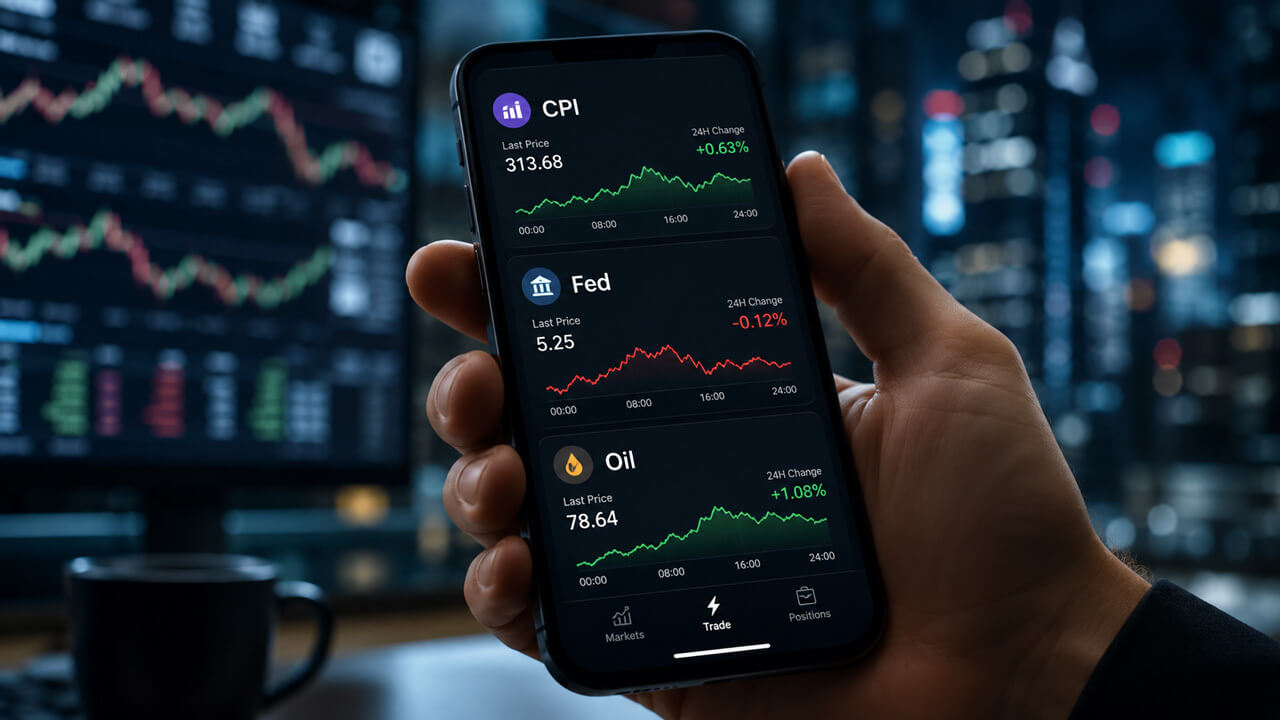



Hyperliquid launched a prediction market this week tied directly to the May US CPI year-over-year reading.
Intercontinental Exchange, the owner of the New York Stock Exchange, announced a partnership with OKX to roll out oil futures contracts that never expire, putting ICE’s Brent and WTI benchmarks in a crypto product with 24/7 trading.
Polymarket, whose prediction markets have recorded nearly $39 billion in US volume so far in 2026, launched a suite of private-company contracts tied to valuation milestones at OpenAI, SpaceX, Anthropic, and Anduril.
Collectively, these represent something much more systematic than just individual product launches: crypto exchanges are moving into tradfi. These three launches (and there’s bound to be more soon) are turning the macro calendar into a live retail trading product collateralized in stablecoins and available for trading around the clock.

Macro data as a consumer product
Prediction markets turn binary questions into prices: a contract might ask whether CPI lands above a specific threshold, or whether a private company reaches a set valuation by year-end. When a contract trades at 43 cents, the market’s expressing roughly a 43% probability for that outcome, with the usual caveats around liquidity, participant mix, and settlement rules.
Perpetual futures let traders maintain ongoing synthetic exposure to an asset or benchmark without a fixed expiry date, using funding payments to keep the contract price anchored near the underlying reference. In crypto, perps became the default instrument for leveraged Bitcoin exposure, and we’re now seeing that same design applied to macro assets long confined to institutional terminals and regulated commodity exchanges.
The OKX and ICE partnership shows just how far that application has traveled. ICE’s Brent and WTI benchmark prices will underpin these never-expiring contracts available across territories where OKX is already licensed to offer perpetual futures, giving OKX’s 120 million retail traders access to energy benchmark products that previously required a commodity brokerage account.
The announcement came as Hyperliquid’s oil perps were already generating roughly $1.6 billion in daily trading volume, a figure large enough to push CME and ICE to press US regulators to pay closer attention to these offshore exchanges.
Hyperliquid’s CPI market takes these even further. Inflation prints already move Bitcoin: traders watch the number, compare it with consensus expectations, then reprice the Fed path, the dollar, yields, equities, gold, and crypto in rapid sequence.
Hyperliquid launched the May CPI year-over-year market with contracts pricing roughly a 43% probability for a reading below 4.3%, settling against the BLS release on June 10. Trading volume at launch was modest, around $3,274.
However, the most interesting data point here is the design itself: crypto exchanges are testing whether official data releases can become reusable market templates, the same way Bitcoin perps became the default for nearly every other crypto derivative.
Polymarket’s private-company expansion addresses a different market gap: most of the world’s most valuable companies can’t be traded by retail investors.
The platform launched 23 markets in its first batch, covering contracts on whether OpenAI surpasses a $1 trillion valuation by year-end, whether Anthropic exceeds $500 billion, and whether SpaceX completes an IPO before 2027, all resolved against Nasdaq Private Market data. Traders have priced Anthropic at roughly 90% probability of hitting $1 trillion by December 31, 2026, and OpenAI at 76% odds of reaching $900 billion by the same date.
These are event-based contracts structured around whether an outcome occurs, with Nasdaq Private Market making the underlying valuation data publicly available for free as part of the deal, creating a real-time probability layer on companies that have raised tens of billions without a single public filing.

When the regulatory framework hasn’t caught up with crypto
We’re now seeing product development running laps around the legal architecture, and it’s creating friction across multiple jurisdictions. The CFTC sued Minnesota this month after the state passed the first explicit statutory ban on prediction markets, criminalizing their operation as a felony under state law.
The CFTC called it the most aggressive state-level incursion into federally regulated markets in the agency’s history. CFTC Chair Michael Selig said the law would turn lawful crypto operators into felons overnight, while Minnesota Attorney General Keith Ellison countered that prediction markets prey on young people and low-income communities.
The question everyone is trying to answer is whether these markets are derivative products governed by federal law or consumer-facing gambling products subject to state regulation, and courts are working through it across at least six states simultaneously.
Europe also found itself facing the same question, but it seems to have gotten there by a different route. Spain’s Consumer Rights Ministry temporarily banned Polymarket and Kalshi this week, citing the absence of mandatory gambling licenses and opening a formal investigation expected to run three to four months. The regulator said that identity-verification systems were missing and there were insufficient controls for minors.
Spain, like most European jurisdictions, treats placing bets on uncertain future outcomes as gambling, making the financial-market and gambling-law frameworks equally plausible classification tools, depending on which ministry is looking. The same crypto product is a regulated derivatives instrument in one country and an unlicensed gambling service in the next.
Market integrity is a separate concern that only compounds as these markets get larger. CPI and Fed decisions have fixed release times and official sources, which keep settlement nice and clean, but private-company valuations, geopolitical events, and corporate milestones are considerably harder to adjudicate.
The more markets depend on external data sources, the more consequential it becomes to know who holds the relevant information first.
Bubblemaps analysts identified a cluster of 80 bets on Polymarket tied to US military actions against Iran with a 98% win rate, a figure they called statistically impossible to explain through luck, raising the possibility that prediction markets could become the venue where sensitive information finds a price before it finds itself in a headline.
The weekend-pricing issue is also pretty underappreciated by observers focused on the legal battles.
When Iran moved to close the Strait of Hormuz in April, crypto traders moved more than $500 million in synthetic oil futures on Hyperliquid over a single weekend while traditional commodity exchanges sat dark. Gold showed the same pattern after strikes on Iranian nuclear facilities in February, when Hyperliquid’s gold perps front-ran CME’s reopen by roughly 48 hours.
Crypto exchanges are already the de facto weekend reference price for macro assets, a role they’ve accumulated through circumstance well before any regulator designated them to do it. The same product that offers a faster way to express a view on inflation or oil can look, depending on who’s using it and where, like a retail speculation engine with macro branding.
Crypto turned tokens into 24/7 global assets, and the version forming now is attempting the same for events, data releases, benchmarks, and private-company valuations. Whether the result is better forecasting, a new hedging layer, or a faster route to consumer harm is a question regulators in at least five countries are actively trying to answer, and the products are scaling faster than the answers.